
The Unknown Soldier is a powerful symbol of the sacrifice and courage of the millions of soldiers who fought, died, or survived in the First World War. But do you know the origin and history of this emblematic figure and his eternal flame?
The idea of honoring an anonymous soldier who represents all the fallen soldiers of a nation came from France, in 1916, but was forgotten until 1920. At that time, France was still mourning the loss of more than 1.4 million soldiers during the war, a tragedy that affected almost every family in the country. We can hardly imagine the brutality and dehumanization that was characteristic of that war. Only a small part can be perceived today by watching images and videos from the battles fought by young people who had no reason to hate each other. But they were put to death, forced to slaughter the others, and had to go through tremendously horrific situations by old men, in nice offices and cozy palaces, who hated each other. Generations of young men died or were crippled for life for reasons that escaped their understanding, or even ours today, no matter what any propaganda will tell us to believe. There is no reason whatsoever to fight in a war. There is nothing heroic or admirable about war. It is just murder, suffering, atrocities, abuses, and senseless, mindless slaughter.
Diplomacy, empathy, shared values, and equitable access to resources are the only ways to have a chance to live in peace. We managed to avoid war in most of Europe in the last 80 years, let’s hope we will succeed in that in the centuries to come too.
But let’s go back to 1920. The French government wanted to pay tribute to these soldiers and give them a dignified remembrance.
The idea was reinforced by the British plan to choose an unknown “Tommy” and bury him at Westminster Abbey, as a way of honoring all the British soldiers who died in the war. The French ego entered the scene and the government decided to be the first to implement this, but with a twist: they would select not one, but eight unknown soldiers from different battlefields, and let one of them be randomly chosen by a wounded veteran.
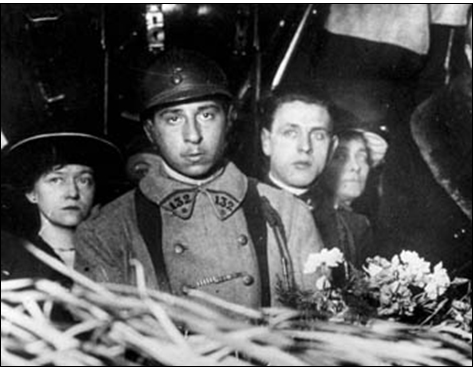
The ceremony took place on November 11, 1920, the second anniversary of the armistice that ended the war. The eight coffins were brought to the Arc de Triomphe, and placed under a black cloth. A soldier named Auguste Thin, a war hero, touched one of the coffins with a bouquet, thus designating the Unknown Soldier. He later said that he had chosen the sixth coffin by adding the numbers of his regiment, 132nd. The coffin was then taken to the Pantheon, where it stayed for one night, before being moved to its final resting place under the Arc de Triomphe.
The tomb of the Unknown Soldier was inaugurated on January 28, 1921, by President Alexandre Millerand. It bears the inscription: “Here lies a French soldier who died for his fatherland 1914-1918”. Since then, it has become a sacred site for the French people, who come to pay their respects and lay flowers on it.
The flame next to the tomb of the Unknown Soldier came later, in 1923 when a journalist named Gabriel Boissy noticed that the tomb looked isolated and abandoned during one evening walk. He suggested that a flame should be lit next to it, as a sign of eternal gratitude and remembrance. The flame was lit at 6 p.m. on November 11, 1923, by Andre Maginot, the Minister of War. The flame is kept burning forever, except for some accidents that have extinguished it temporarily.
Not all people are inspired by the message of the flame. In 2002 a soldier with mental health problems was arrested for trying to urinate on it, another man burnt himself the previous year after sitting over the flames and another was previously arrested for trying to cook eggs there. In 2014 a drunken passerby tried to stop it with a fire extinguisher. Nobody thought this was funny and the man was arrested.
The flame is rekindled every day at 6:30 p.m. by a group of veterans or volunteers, who also recite a solemn oath: “We swear to keep watch over this flame with our faith and our love”. The flame is also rekindled on special occasions, such as national holidays or visits by foreign dignitaries. Many famous people have rekindled the flame, such as Winston Churchill, John F. Kennedy, Charles de Gaulle, Nelson Mandela, and Angela Merkel.
The tomb of the Unknown Soldier and his flame are not only symbols of France’s history and identity but also of its commitment to peace and democracy. They remind us of the horrors of war and the need to prevent them from happening again. They also inspire us to honor and respect those who have given their lives for freedom and dignity. Many other countries implemented the same ceremony and ritual to honor The Unknown Soldier.
If you want to learn more about the Unknown Soldier and his flame, you can visit the official website of the Arc de Triomphe (https://www.paris-arc-de-triomphe.fr/en/), where you can find more information and photos. You can also watch or listen to the video version of this article on YouTube.
We hope you enjoyed this blog post and learned something new. If you did, please share it with your friends and family on social media. And don’t forget to leave us a comment below and tell us what you think about this topic. Thank you for reading!
 Ink And Reason