
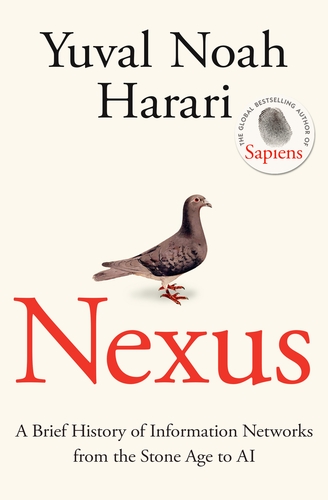
Let me start with a confession: I have spent a good part of my life in professions where information is the currency. In some of them, bad information can cost far more than money. So when Yuval Noah Harari announced a book about information networks “from the Stone Age to AI,” I thought: finally, someone will explain to me why my WhatsApp family group is a more powerful disinformation machine than most intelligence services I know of.
Spoiler: he does. Sort of. And it’s brilliant.
Nexus opens with Goethe’s Sorcerer’s Apprentice, the young man who enchants a broom to do his chores and then can’t make it stop. You can guess who plays the apprentice in this story (us) and who plays the broom (the thing currently writing your emails). From there, Harari takes us on a ride through 100,000 years of humans telling each other stories, writing them down, filing them, and then believing the files more than reality.
Why You Should Read This Book (Even If You Think You Know Where It’s Going)
- It demolishes the “naive view of information.” The comforting idea that more information automatically means more truth and wisdom gets a proper burial. Information, Harari argues, is first of all what connects people. Whether it also tells the truth is optional. Which, honestly, explains the evening news.
- The historical examples are delicious (and a bit terrifying). Take the European witch hunts. A single book, the Malleus Maleficarum, plus the brand-new printing press, turned a bizarre fantasy into a continent-wide bureaucracy of torture. Or the Soviet invention of the “kulak,” a category that existed mainly on paper but destroyed millions of very real lives. Or the debates over which texts made it into the Bible: an “infallible” book still needed a committee of very fallible humans to decide what was in it.
- The AI part is where it gets personal. The example that stuck with me is Facebook’s algorithm in Myanmar. Nobody told it to fuel hatred against the Rohingya. It was simply told to maximize engagement, and outrage engages beautifully. Then there’s AlphaGo’s famous Move 37, which no human would have played. And the GPT-4 test in which the model persuaded a TaskRabbit worker to solve a CAPTCHA for it, claiming it was a human with poor eyesight. Working in healthcare, where AI is already reading scans and suggesting diagnoses, I closed the book with both excitement and a strong urge to double-check everything.
Who Should Maybe Take a Deep Breath Before Diving In
- Tech optimists who believe every problem has an app. Harari is not anti-technology, but he is very skeptical of the idea that the market will sort it out. Bring a stress ball.
- Readers who want a technical manual on AI. This is a book about people, power, and institutions. If you want to know how neural networks work, you’ll find more equations on a cereal box.
- Anyone hoping for a light read before bed. It’s long, and it occasionally wanders. Like a good Romanian uncle at a wedding, it always comes back to the point, eventually.
The Verdict: Five Stars, and a Lot of Homework
What I loved most is that Harari doesn’t just ring the alarm bell. His real heroes are the boring ones: institutions with strong self-correcting mechanisms, the kind that admit mistakes and fix them. That means free courts, a free press, science, and democracies that can vote the idiots out. In a world where we risk building a “silicon curtain” between competing digital empires, that message feels less like philosophy and more like a survival manual.
I gave Nexus five stars on Goodreads, and I’d give it six if they let me. Read it, argue with it, and then look at your phone a little more suspiciously. It’s probably reading you too.
Nexus: A Brief History of Information Networks from the Stone Age to AI, by Yuval Noah Harari: https://www.goodreads.com/book/show/204927599-nexus
If you enjoy my work, you can support me by buying me a coffee or one of my books. ☕📚